


Virgin, Raw, Rare: Why Consumer Hair Terminology Fails Professional Procurement
If you work in professional hair procurement, for a production, a luxury atelier, a medical hair loss practice, or an institutional costume department, you have almost certainly encountered the terminology problem. The words used to describe hair quality in the consumer market do not mean what they appear to mean. And in a professional context, that imprecision has real consequences on multiple levels.

How the language broke
When I started in the hair industry in 1987, the term virgin hair entered the market as a quality indicator: hair that had never been chemically processed or altered. For a period, it held. Then volume demand created pressure on supply, and suppliers began applying the label to hair that had been lightly processed, acid-washed, or steam-treated, enough to restore a natural appearance, not enough, in their assessment, to disqualify the claim. The word did not change but the standard behind it did.
Raw hair emerged partly in response to this. The implication was unprocessed at a more fundamental level, single donor, collected directly, with no factory intervention. But raw is not a regulated term either. For some time on both the internet and social media it was applied to anything a vendor wished to position as premium. A search for raw hair on any social platform returns thousands of listings using the word to mean everything from single-donor temple hair to multi-donor factory bundles with a convincing origin story.
The geography problem
The terminology breakdown is compounded by a parallel fiction: geographic origin claims. Brazilian hair, Peruvian hair, Cambodian hair, these designations entered the market as quality signals tied to specific donor populations and their hair characteristics. They are now almost entirely decorative. The majority of hair sold under these geographic labels is processed, blended, or factory-finished product that has no traceable connection to the country named on the listing.
This is not a just rfinge problem, it is the operating norm of the consumer market. The labels persist because they sell, not because they correspond to anything verifiable. For a professional buyer who needs to specify, repeat, and defend a sourcing decision, a geographic label with no basic traceability behind it is not information.
The single-donor claim
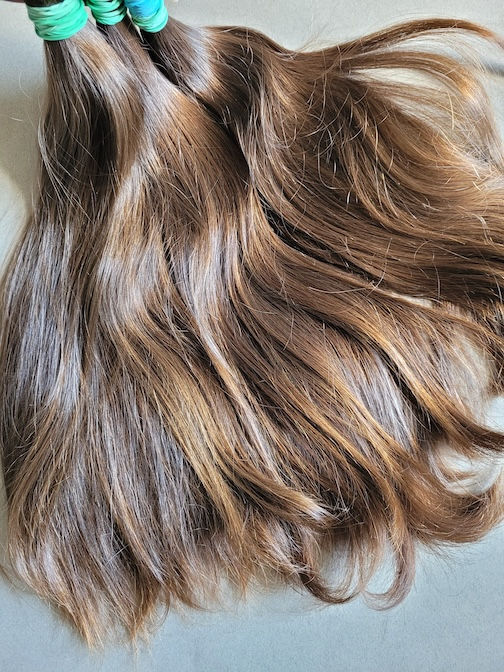
Single-donor hair, hair collected from one individual, with cuticle alignment intact and no blending, carries a particular quality premium in professional use. It is also one of the most frequently falsified claims in the market. The visual difference between true single-donor hair and a well-processed blend is not apparent to the untrained eye before purchase. It becomes apparent later, under heat, under repeated handling, or under the conditions of professional use, after the transaction is long closed.
Why this matters for professional buyers
A consumer buyer who receives misrepresented hair is disappointed. They leave a review and return the product if the policy allows.
A professional buyer who receives misrepresented hair has a different problem. A wig built on incorrect material fails under performance conditions, under stage lighting, across an eight-show week, or in front of a camera operating at resolutions that expose every inconsistency. A luxury product line built on a supply that cannot be repeated or traced creates a compliance and brand integrity exposure. A medical prosthetic sourced to the wrong specification affects a patient outcome. The stakes are not the same, and the terminology, developed entirely in the consumer market, was never built to carry professional weight.
What the professional market is actually buying
When institutional buyers, production companies, luxury houses, medical specialists, source hair through professional channels, they are not simply buying a material. They are buying the reliability of a specification.
They need to know that what arrives matches what was agreed, that it can be sourced again to the same standard if needed, and that the claim made about it can be defended if questioned.
None of that is available from a consumer market built on unregulated terminology, unverifiable origin claims, and a sales model optimised for volume rather than consistency. The professional buyer is not a more demanding version of the consumer buyer. They are operating in a different procurement context entirely, one that the consumer market's language was never designed to serve, and cannot.
The consumer market built this language for itself. It was never designed to carry institutional weight, and it does not. Professional buyers who understand this do not try to correct the terminology. They simply work outside it.
Beth Thompson is the founder of Lux Symbolica, a Paris-based B2B rare hair curation and sourcing service operating at the intersection of professional expertise, forensic science standards, and the luxury supply chain.
Professional enquiries by authorization only.
© 2026 Lux Symbolica SASU
Join me on LinkedIn where I explore these topics with other professionals.


Comments