


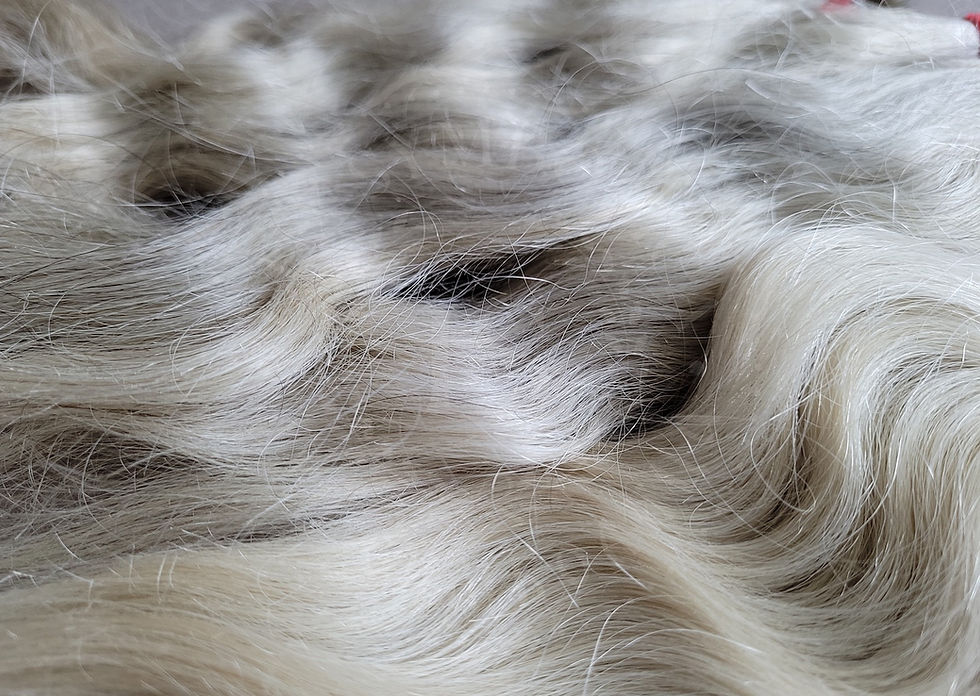
Why Does Grey Hair Appear Like Shiny Silver? The Optics and Biology Behind the Phenomenon
Updated: Sep 28
The science below represents our current foundational understanding of hair pigmentation loss and optical physics. While these biological processes are well-documented, experienced professional colorists understand how to work with — and enhance — the unique structural properties of silver and grey hair to achieve extraordinary results.
The Short Answer
Grey hair does not contain silver. It contains no meaningful pigment at all. The metallic shimmer you see is a purely optical phenomenon — the result of light interacting with a translucent keratin fiber that has lost its melanin absorbers. Understanding why requires a journey through cellular biology, oxidative chemistry, and the physics of light scattering.

The Biology: Why Melanin Disappears
Hair color originates in the hair follicle pigmentary unit (HFPU), where specialized cells called melanocytes synthesize and inject melanin granules into the growing hair shaft. This process depends entirely on a population of melanocyte stem cells (McSCs) residing in the follicle bulge — a protected niche that replenishes melanocyte supply with each new hair growth cycle.
Landmark research published in Science (Nishimura et al., 2005) established that hair greying is caused by defective self-maintenance of McSCs within their niche, not simply by the death of mature melanocytes. Over time, McSCs progressively fail to return to the hair germ compartment after each cycle — becoming irreversibly "stranded" in the bulge where they can neither produce new pigment cells nor function as true stem cells. A 2023 NIH study confirmed this mechanism, demonstrating that McSCs which lose their migratory capacity between the bulge and hair germ become permanently unable to participate in pigmentation, a process the researchers described as the loss of "chameleon-like function" in the stem cells themselves. nih+1
Once the McSC pool is exhausted, hair greying becomes irreversible under current therapies.[pmc.ncbi.nlm.nih]
The Chemistry: The Hydrogen Peroxide Cascade
Alongside stem cell depletion, a parallel chemical process accelerates pigmentation loss. Research published in the FASEB Journal (Wood et al., 2009) demonstrated that greying hair follicles accumulate massive levels of endogenous hydrogen peroxide (H₂O₂) — produced as a natural metabolic byproduct of normal cell activity. In young follicles, the enzyme catalase efficiently breaks this H₂O₂ down into water and oxygen before it can cause damage. In greying follicles, catalase activity is significantly reduced, allowing H₂O₂ to accumulate unchecked. heyhair+1
The consequences are compounding:
Accumulated H₂O₂ directly inhibits tyrosinase — the master enzyme responsible for melanin synthesis — blocking remaining melanocytes from producing pigment even when they survive[heyhair]
H₂O₂ causes oxidative modification of hair shaft proteins, disrupting the keratin matrix structure and contributing to changes in light interaction[heyhair]
Reduced activity of methionine sulfoxide reductase A and B (MSR A and B) further prevents follicles from repairing oxidative damage to melanocytes [eurekalert]
This creates a self-reinforcing cascade: less catalase → more H₂O₂ → damaged melanocytes → less pigment → more oxidative vulnerability.
The Stress Connection

Research published in Nature (Zhang et al., 2020) provided the first rigorous scientific evidence that acute psychological stress accelerates greying through a distinct biological pathway. Stress triggers sympathetic nervous system activation, causing burst release of the neurotransmitter norepinephrine into the McSC niche. This drives quiescent McSCs into rapid, and unsustainable, proliferation, followed by differentiation and permanent depletion from the follicle bulge. Critically, this mechanism was shown to be independent of immune attack or cortisol — it operates directly through neural innervation of the stem cell niche, explaining why stress-induced greying can occur rapidly and in localized patterns. [pmc.ncbi.nlm.nih]
The Optics: Why Grey Hair Looks Silver
Once melanin is absent, the physical structure of the hair fiber itself becomes the sole determinant of its optical appearance. Three interconnected phenomena produce the characteristic silver sheen:
1. Loss of Light Absorption
Melanin — particularly eumelanin — has a high absorption coefficient across the visible spectrum, with preferential absorption at shorter wavelengths (blue/green light), which gives dark hair its characteristic depth. Research published in the Journal of Biomedical Optics confirmed that lightly pigmented hair has a scattering coefficient approximately four to five times higher than that of black hair, because melanin in dark hair absorbs much of the light before it can scatter. Without melanin, grey hair reflects all wavelengths approximately equally, producing a neutral, achromatic — metallic — appearance. [pmc.ncbi.nlm.nih]
2. Keratin's Refractive Index and Internal Reflection
The keratin matrix of the hair cortex has a refractive index of approximately 1.54–1.59 across the visible spectrum. This is significantly higher than air (1.0), which means light entering the hair shaft slows, bends, and undergoes total internal reflection at the boundary between the fiber and the surrounding air. Without melanin to absorb this internally bouncing light, it exits the fiber with high intensity across all angles, producing the luminous, multi-directional shine characteristic of silver hair. spiedigitallibrary+2
3. The Cuticle as a Diffraction Grating
The cuticle's tightly overlapping scale structure functions as a biological diffraction grating — reflecting light coherently at specific angles in a manner that mimics the surface behavior of polished metal. Research using Mueller matrix imaging confirmed that single dark hairs exhibit high diattenuation values (directional light absorption/reflection) due to melanin, while lighter and unpigmented hair produces more diffuse, multi-directional light scattering — the classic "frosted" or "iced" visual effect. [pmc.ncbi.nlm.nih]
4. The Umov Effect
A 2024 PMC study on the polarization properties of human hair documented what is known as the Umov effect in grey hair: multiple scattering events at specific wavelengths increase the albedo (overall light reflectance) while simultaneously decreasing the polarization of scattered light. This produces a broad, even luminosity rather than a single directional glare, precisely the quality that makes silver hair appear to glow rather than simply reflect.[pmc.ncbi.nlm.nih]
What This Means for Professional Colorists
Understanding these mechanisms has direct practical implications:
Grey hair's elevated porosity — caused by both age-related cuticle changes and H₂O₂-induced protein modification — means it absorbs color rapidly and unevenly. Pre-treatments that normalize porosity before color application are not optional; they are chemically necessary.
The high scattering coefficient of unpigmented hair means toners and semi-permanent colors deposit differently than on pigmented hair — sheer, translucent formulas often yield more predictable results than opaque ones.
The intrinsic luminosity of grey hair is a Research published in Nature (Zhang et al., 2020) confirmed that acute psychological stress triggers sympathetic nervous system activation, driving irreversible depletion of melanocyte stem cells — and accelerated greying — through direct neural innervation of the follicle niche.structural asset. Enhancing rather than masking the optical properties of grey — through glossing, bond-building, and cuticle-smoothing treatments — consistently produces more sophisticated results than fighting the fiber's natural physics.
Experienced professional colorists who understand the optical and biochemical properties of grey hair can unlock results that are impossible to achieve through chemistry alone. The silver is already there — the skill lies in working with the physics, not against it.
©2026 LUX SYMBOLICA®
Beth Thompson is the founder of Lux Symbolica SASU, a Paris-based independent B2B authority in rare hair sourcing and curation, and a member of IATSE Local 706.
References
Nishimura EK, Jordan SA, Oshima H, et al. Mechanisms of hair graying: incomplete melanocyte stem cell maintenance in the niche. Science. 2005;307(5710):720–724. doi: 10.1126/science.1099593
Wood JM, Decker H, Hartmann H, et al. Senile hair graying: H₂O₂-mediated oxidative stress affects human hair color by blunting methionine sulfoxide repair. FASEB J. 2009;23(7):2065–2075. doi: 10.1096/fj.08-125435
Zhang B, Ma S, Rachmin I, et al. Hyperactivation of sympathetic nerves drives depletion of melanocyte stem cells.Nature. 2020;577(7792):676–681. doi: 10.1038/s41586-020-1935-3. PMC7184936
Rosenberg AM, Rausser S, Ren J, et al. Quantitative mapping of human hair greying and reversal in relation to life stress. eLife. 2021;10:e67437. doi: 10.7554/eLife.67437
Mochii M, Ochi H, Ogino H. Polarization properties and Umov effect of human hair. PMC. 2024. PMC10764807
Bashkatov AN, Genina EA, Tuchin VV. Review of human hair optical properties in possible relation to light–tissue interactions. J Biomed Opt. 2018;23(5):050901. doi: 10.1117/1.JBO.23.5.050901
Knüttel A, Boehlau-Godau M. Spatially confined and temporally resolved refractive index and scattering evaluation in human skin performed with near-infrared reflectometry. Characterization of human scalp hairs by optical low-coherence reflectometry. PubMed. 1995. PMID: 19859243
Trüeb RM. Oxidative stress and its impact on skin, scalp and hair. Int J Cosmet Sci. 2021. doi: 10.1111/ics.12736


Comments