


Is Grey Hair Actually Translucent? The Optical Physics Behind the Question Colorists Cannot Ignore
If you have ever watched a professional hair dye fade within weeks on grey hair, while holding perfectly on the rest of the head, you have witnessed a physics problem disguised as a chemistry one.
The answer begins with a single, counterintuitive fact: grey hair is not grey. It is, structurally speaking, transparent.

A Fiber Without a Filter
Human hair gets its color from melanin granules packed into the cortex, the inner cylinder of the hair shaft. Two melanin types govern this: eumelanin (brown to black tones) and pheomelanin (yellow to red tones). These pigments function as selective light absorbers, capturing specific wavelengths and giving each strand its characteristic color. As established in optical measurements of hair fibers, melanin concentration is the primary factor governing light absorption, and blond hair with as little as 0.06% melanin content has measurably higher light transmission than black hair at 2% melanin content; grey and white hair sit at effectively zero (van Kampen, 1997).¹
That absence is the core of everything. In the visible spectrum, keratin and water are essentially transparent, melanin alone is the absorbing factor in the visible domain (van Kampen, 1997).¹ Without melanin to intercept wavelengths, incoming light passes through the cortex, bounces off internal structures, and exits as scattered white light. The strand you perceive as "grey" or "silver" is, in isolation, colorless.
How Light Moves Through a Depigmented Strand
The interaction of light with a hair fiber follows two simultaneous pathways. The first is specular reflection: light bouncing directly off the outer cuticle surface, returning the same wavelength composition as the incident light, which is why white light produces a white or silver highlight. The second is subsurface scattering: light that refracts through the cuticle, travels into the cortex, and re-emerges after interacting with internal structures. As Saini (2011) describes in the International Journal of Trichology, "in gray hair, the hair shaft does not store pigment; the production of melanin has subsided and the melanin is replaced with deposited air bubbles."²

These vacuoles become additional scattering centers, amplifying diffuse reflection across all visible wavelengths.
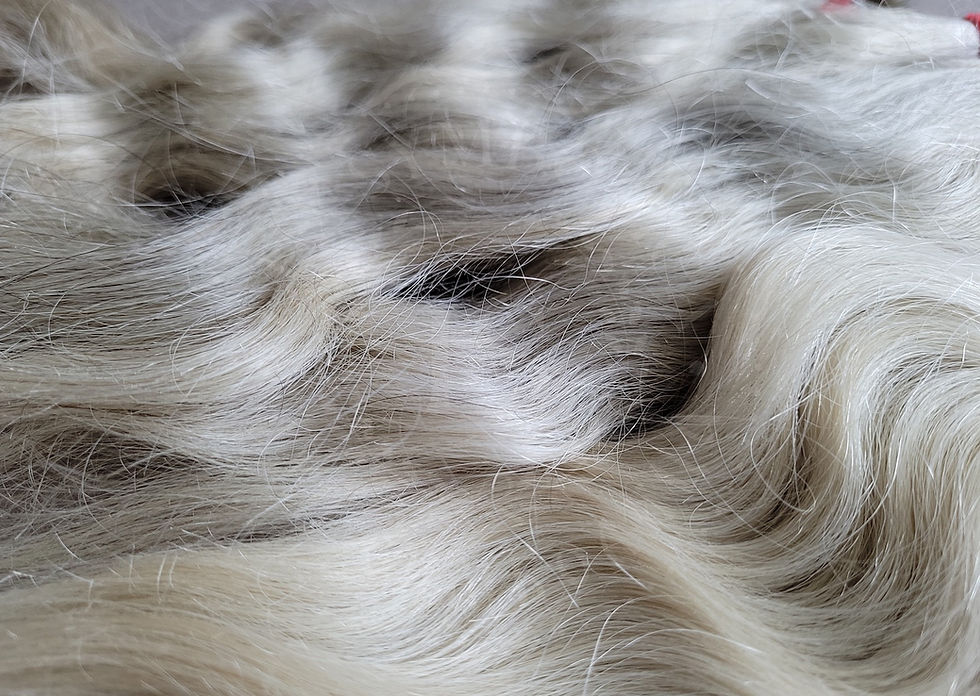
The cuticle scale architecture creates a further optical consequence. Guiolet, Garson, and Levecque (1987), studying the optical properties of hair by photogoniometry at the L'Oréal research laboratory, demonstrated that the overlapping cuticle scales cause specular and internal reflections to follow different angular directions, producing two separate peaks of light return.³ In grey hair, because no melanin tints the internal reflection, both peaks carry the same unfiltered white light, which is why grey hair appears to glow or shift color depending on the angle and light source.
Research published in Scientific Reports (2024) on the polarization properties of human hair further confirmed that lightly pigmented hair has a scattering coefficient approximately four to five times higher than black hair, and that higher scattering is directly linked to increased albedo, the proportion of light reflected rather than absorbed (Vizet et al., 2024).⁴ This is why grey hair appears luminous and why its appearance shifts so dramatically depending on the surrounding light environment.
Why This Makes Grey Hair Resist Permanent Color
This translucent, air-filled cortex structure is precisely what makes grey hair one of the most technically demanding substrates for professional color. Three mechanisms are at work.

First, porosity is deceptive. Without melanin granules that naturally maintain cortex volume during growth, the cuticle scales on depigmented hair tend to compact more tightly. Gosain and Bhatt (2009), measuring optical coefficients in the Journal of Biomedical Optics, found that the cortex of grey and blond hair is "extremely weakly scattering", meaning it is denser and more uniform in composition, while the medulla exhibits a very large scattering coefficient.⁵ This tight cortex limits the penetration of large oxidative dye molecules.
Second, the air vacuoles actively interfere with dye retention. The same air pockets that scatter light also occupy space within the cortex that would otherwise be taken up by keratin matrix. Dye molecules deposited near these vacuoles are particularly vulnerable to displacement by water and heat during subsequent washing, as they lack the surrounding protein scaffold that would anchor them in fully cortex-packed pigmented hair.
Third, the translucency amplifies perceived color distortion. Because light scatters so freely inside the depigmented cortex, even a correctly deposited color molecule is perceived through a complex optical environment. The absence of a background melanin "base tone" means the deposited dye color is seen against scattered white light, which can make cool tones appear violet-shifted and warm tones appear initially more saturated before fading to brass. Near-infrared microscopy studies of chemically treated hair have demonstrated that damage within the cortex is optically detectable precisely because the keratin matrix of low-melanin hair allows greater light penetration (Yamashita et al., 2024).⁶
This is why seasoned colorists working with predominantly grey clients often rely on pre-softening protocols, longer processing times, and formulations with dedicated grey coverage chemistry, not because the hair is chemically resistant, but because it is optically and structurally unlike any pigmented fiber.
The Takeaway for Professionals
Grey hair is not a color. It is an optical behavior produced by a translucent keratin cylinder, air vacuoles, and the complete absence of light-absorbing melanin. Understanding it through the lens of fiber optics, rather than purely as a pigmentation deficiency, reframes how color deposition, longevity, and tone correction can be approached. The physics do not lie: a fiber that scatters all wavelengths equally cannot hold selective color the same way a fiber that absorbs them can.
©2026 LUX SYMBOLICA®
Beth Thompson is the founder of Lux Symbolica SASU, a Paris-based independent B2B authority in rare hair sourcing and curation, and a member of IATSE Local 706.
References
van Kampen TF. Optical properties of hair [Master's thesis]. Eindhoven University of Technology / Philips Research; 1997. Available via: pure.tue.nl
Saini R. Optical detection of hairs. International Journal of Trichology. 2011;3(2):128–129. doi:10.4103/0974-7753.90849. PMC3250015.
Guiolet A, Garson JC, Levecque JL. Study of the optical properties of human hair. International Journal of Cosmetic Science. 1987;9(3):111–124. doi:10.1111/j.1467-2494.1987.tb00468.x. PMID:19456974.
Vizet J, Iachina I, Lemaillet P, et al. Polarization properties and Umov effect of human hair. Scientific Reports. 2024;14:265. doi:10.1038/s41598-023-50457-x.
Gosain M, Bhatt P. Optical properties of the medulla and the cortex of human scalp hair. Journal of Biomedical Optics. 2009;14(2):024035. doi:10.1117/1.3116710.
Yamashita T, et al. Optical evaluation of internal damage to human hair based on near-infrared circular polarization microscopy. International Journal of Cosmetic Science. 2024. doi:10.1111/ics.12970. PMID:38802700.

Comments